
Finding a 4-Inch PVC Water Main Without Tracer Wire
A Challenging Locate at Antioch University in Yellow Springs, Ohio
When you are working on a property with more than 170 years of history, you cannot always expect the utilities underground to match the drawings above ground.
Antioch’s history in Yellow Springs, Ohio, dates back to 1852. Over the decades, buildings have been added, renovated and repurposed, while underground infrastructure has been installed, repaired and modified along the way.
That history created an interesting challenge when a contractor needed to locate a buried 4-inch PVC water line, tee and valve manifold on the Antioch University campus.
The records available to the crew weren't detailed enough to confidently determine the water line's location. Making matters more difficult, the line was buried approximately five feet deep in dense clay.
There was no tracer wire to follow. The valve sleeves were PVC, the lids were plastic, and approximately a foot of soil covered the access points.
To make the locate even more critical, gas lines and three-phase electrical conduits were also present in the area.
Simply estimating where the water line should have been an acceptable option.
When Traditional Locating Methods Hit a Wall
Most electromagnetic utility locating depends on having a conductive path.

A metallic pipe, tracer wire or another conductive component allows an EM locator to apply and follow a signal. With a PVC water line and no tracer wire, that conductive path wasn't available here.
Metal detection wasn't much help either. The buried valve sleeves and lids were plastic, leaving very little metallic material to identify.
Ground-penetrating radar could potentially have been used, but the conditions presented their own challenges. Dense clay, roughly five feet of cover and several other utilities in the same area can make interpreting GPR data considerably more difficult.
Physical excavation would provide the final confirmation, but first the crew needed to answer the most important question:
Where should they dig?
Using Sound Instead of an Electromagnetic Signal
The crew had access to a valve approximately 480 feet away from the suspected location of the buried manifold.
That valve became the connection point for the SonicFinder 1000.
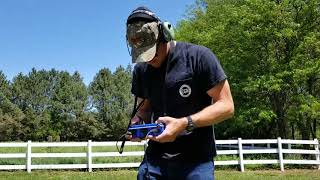
Brad Horton of Solinas Technologies connected the system at the accessible valve and began working across the site with the handheld receiver. Rather than requiring electrical continuity through the utility, the SonicFinder uses acoustic response to help identify non-metallic buried pipe.

The response was followed across the property from the connection point toward the target area.
Even with nearly 480 feet between the accessible valve and the buried assembly, Brad was able to trace the 4-inch PVC line and narrow down the location of the tee and valve manifold.
That is an important distinction for anyone accustomed to traditional EM locating.
An electromagnetic locator needs something conductive to carry its signal. Acoustic locating approaches the problem differently, making it particularly useful when crews encounter plastic utilities without functional tracer wire.
From Search Area to Excavation Point in About 30 Minutes
From beginning the locate to identifying the target area, the process took approximately 30 minutes — with a little time mixed in for the usual jobsite conversation.
Once the location was identified, excavation provided the final verification.
At the bottom of the excavation was exactly what the crew had been looking for: the 4-inch PVC water line, tee and buried valve manifold.
Instead of using excavation to search blindly for the utility, the contractor could use excavation to confirm a location that had already been narrowed down.
That distinction can make a significant difference on a jobsite.
Vacuum excavation equipment in the area can cost approximately $3,000–$3,500 per day. While this particular locate did not eliminate an entire day of vacuum excavation or automatically create a $3,500 savings, it helped reduce unnecessary exploratory work.
The crew knew where to focus its efforts rather than spending valuable time opening holes simply to determine where the line went.
Why This Was a Tough Locate
Several conditions came together to make this project more challenging than a typical utility locate:
4-inch non-metallic PVC water line
No tracer wire
Approximately five feet of burial depth
Dense clay soil
Plastic valve sleeves and lids
Roughly one foot of soil covering the access points
Incomplete utility records
Nearby gas and three-phase electrical utilities
Connection point approximately 480 feet from the target
This wasn't a demonstration on a controlled test site. It was a real utility locate with the same variables contractors and utility professionals encounter every day.
Choosing the Right Tool for the Utility
There is no single locating technology that works perfectly for every underground utility.
EM locating is extremely effective when a usable conductive path exists. GPR can provide valuable information when soil conditions and target characteristics allow for a clear response. Vacuum excavation gives crews physical verification of what is underground.
Each method solves a different part of the problem.
For non-metallic utilities, acoustic locating adds another option to the toolbox — particularly when tracer wire is missing, damaged or simply was never installed.

The Result
At Antioch University, an accessible valve nearly 480 feet away provided the starting point for locating a buried 4-inch PVC water line.
Using the SonicFinder 1000, the line was followed into a congested area containing other utilities, and the location of the buried tee and valve manifold was identified in approximately 30 minutes.
Excavation then confirmed the location.
For contractors and utility crews working with PVC and other non-metallic pipe, situations like this are exactly why having more than one locating method matters.
When tracer wire isn't available, the question doesn't have to be “Where do we start digging?”
It can be:
“What other method can we use to find it first?”
Read the original article Locating a Buried PVC Water Line at Antioch | Solinas




Comments